Our healthcare system is straining under unprecedented pressure. The consequences are stark:
- Canada ranks near the bottom among OECD countries in operational efficiency, including in the Commonwealth Fund’s Mirror, Mirror healthcare report.
- Wait times for medically necessary care cost Canadian workers over $5 billion in lost wages annually—nearly $3,000 per affected patient.
- The economic value of unpaid caregiving in Canada exceeds $97 billion annually, based on an estimated 5.7 billion hours of care work contributed by family caregivers each year.
- Workforce participation diminishes as chronic conditions go unmanaged and preventable illnesses escalate.
- When treatment for common illnesses is unnecessarily delayed, that treatment often becomes more complicated, more expensive, and is less likely to provide an optimal health outcome.
Healthcare is not only a moral imperative—it’s an economic engine. A healthier population is a more productive one. Health also drives equity: Canadians value universal care not just as a service, but as an expression of who we are.
However, what got us here will not get us to where we need to be. We must think differently from our institution-centric care model. The urgency has never been greater given the challenging economic and geopolitical environment Canada faces. A modernized healthcare system would drive innovation, attract investment, and reduce the fiscal drag caused by inefficiency and lost output. It’s a massive driver for competitiveness precisely when we need it most.
A New Model for a New Era: Comprehensive Healthcare at Home
At CHAH Technology and Stay at Home Nursing, we believe Canada’s most powerful lever for change lies in redefining where and how care happens.
Our model—Comprehensive Healthcare at Home—proposes a national shift toward proactive, technology-enabled, home-based care.
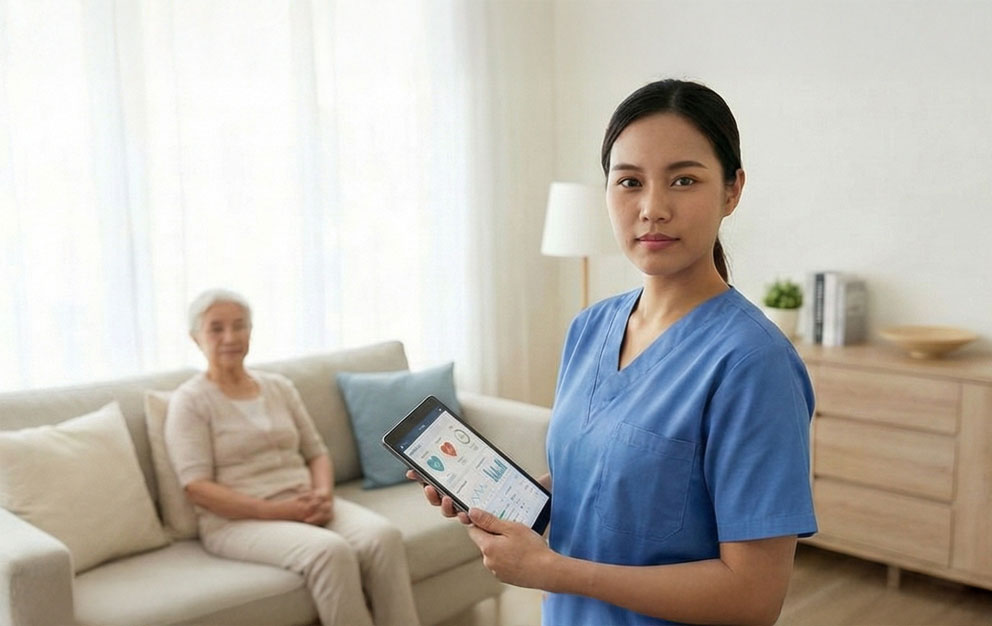
Our front-line nurses and their colleagues across Canada are evolving rapidly as this home-based care expands. They’re part of a critical shift from institution-centric models to personalised technology-driven care delivered in patient homes. Nurses are now managing complex, acute conditions outside hospitals, requiring increased autonomy, critical thinking, and proficiency with remote monitoring technologies.
The Critical Changes in Nursing Driven by Home-Based Care
Advanced Clinical Roles: Home care nurses now perform complex procedures—such as intravenous treatments, wound care, and stoma management—that were once restricted to hospitals.
Technology Integration: Remote, real-time vital signs monitoring and smart technologies enable proactive management, reducing hospital readmissions and improving patient safety.
Holistic and Autonomous Care: Nurses operate with greater independence, acting as case managers who bridge gaps between patients, families, and medical teams.
Shift in Focus: Care is more personalized and comfortable, addressing complex needs caused by an aging population while promoting dignity and quality of life.
Workforce Flexibility: The growth in home care offers diverse, flexible opportunities for nurses—freelance, part-time, and full-time—often with better work-life balance compared to traditional hospital shifts.
This shift also requires new skills in navigating the unique environment of a patient’s home and managing patient and family expectations.
Just twenty years ago, nursing was defined almost entirely by what happened at the bedside. Tools were hands-on, training was grounded in apprenticeship-style learning, and the word “technology” referred to the ECG machine in the corner.
Today, the core of nursing—compassionate, patient-centered care—remains unchanged. But almost everything around it has transformed. The role of the nurse is no longer confined to the bedside. Nurses can now lead telehealth consultations, manage complex chronic conditions remotely, deploy sophisticated remote monitoring tools, and shape preventative health strategies that touch lives before illness strikes.
This isn’t a slow shift. It’s a revolution for the nursing profession.
We need to continue to drive this deeper integration of nursing beyond the hospital and bedside, into all Canadian communities. Nurses can be deployed as “Healthcare Navigators” to guarantee access to health guidance and care. Imagine every Canadian with a designated nurse Navigator—a trained RN supported by AI, responsible for ~1,000 citizens in respective postal codes / neighbourhoods. This would:
-
- Guarantee annual in-home checkups.
- Catch deterioration early.
- Drastically reduce ER overload while improving access to chronic and preventative care.
With a comprehensive universal healthcare-at-home approach chronic conditions would be managed in a more timely and effective manner, hospital admission (and re-admissions) would be lowered, and wait times for critically necessary procedures would be reduced. Nurse Navigators would lead the way in decreasing the current strain placed on our healthcare system
At Stay at Home Nursing and CHAH AI Care, we are proud of our front-line nurses and their impact for clients who want to age in place and stay at home longer.
And if you want to hear more about our vision, please contact us! We are actively hiring nursing staff and enabling comprehensive healthcare at home. Come join the home team!