Canadian ERs struggle every winter – but this year, home-based predictive care may be our best defence
Across Canada, hospitals are preparing for what could be another difficult winter. In the Southern Hemisphere, a more aggressive flu strain spread faster and caused more severe illness than expected. Now, Canadian experts warn we may face the same pattern.
Under normal circumstances, flu season is challenging. But in today’s Canada – with ERs already overcrowded, long-term care homes full, and six million people without a family doctor – even a moderate surge in influenza can push the system to its limits.
And that should concern all of us.
A System So Fragile It Nearly Collapsed From a Few Hundred Patients
Canada learned something sobering during COVID-19: it didn’t take tens of thousands of critically ill patients to overwhelm our healthcare system.
It took a few hundred.
A small increase in ICU admissions triggered a nationwide chain reaction:
- ERs backed up
- Ambulances waited hours to offload patients
- Surgeries were cancelled
- Staff burned out
- Long-term care homes were left without support
Our system came dangerously close to a cascade failure – not because the virus was unstoppable, but because our margin for error had shrunk to almost zero. Today, that fragility remains.
This is why a tough flu season isn’t “just the flu.” It’s a stress test of a system already stretched thin – a reminder that the next serious respiratory virus could break through the cracks we haven’t repaired.
This Winter’s Priority: Keep People Out of the ER
Every province is focused on the same goal: reduce avoidable emergency room visits and prevent unnecessary hospital admissions.
That means:
- catching health issues earlier
- supporting vulnerable adults at home
- giving families safe alternatives to the ER
This is where home-based predictive care stops being a nice idea – and starts becoming essential infrastructure.
What Presilience Looks Like in Real Life
We talk a lot about “resilience” in healthcare – the ability to recover from crises. But what Canada needs now is presilience: the ability to avoid preventable crises before they ever reach a breaking point.
Consider something as ordinary – and deceptively dangerous – as a urinary tract infection (UTI) in a senior.
Across Canada, untreated UTIs send tens of thousands of older adults to hospital every year. Many arrive confused, dehydrated, or in medical distress. A UTI that could have been resolved at home with a $20 course of antibiotics becomes a $20,000 hospital stay, often requiring IV fluids, days of monitoring, 8.1% mortality, and sometimes long-term complications.
This is not theoretical – it is one of the top avoidable causes of hospitalization among seniors in Canada. Now imagine a different path.
Predictive care at home catches the problem early:
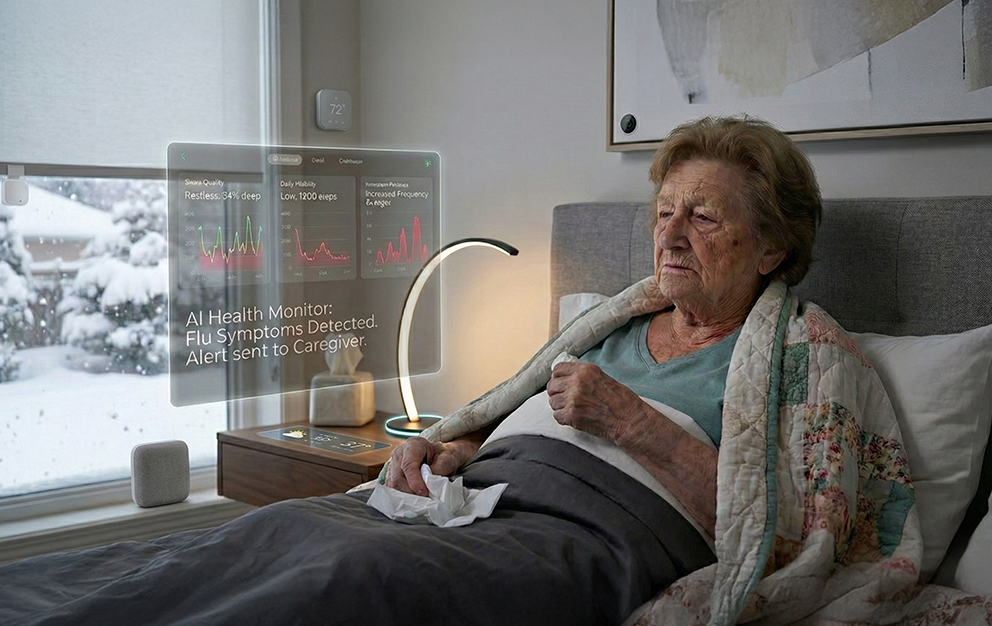
- CHAH’s home monitoring detects subtle changes in sleep, mobility, behaviour, or bathroom patterns.
- A nurse navigator checks in, runs a simple in-home rapid test, and confirms early infection.
- Antibiotics are delivered the same day.
- The senior stays home – safe, stable, recovering.
- The ER never enters the picture.
- A hospital bed is preserved for someone who truly needs it.
That is presilience. A crisis prevented. An ER visit avoided. A life kept steady – quietly, safely, at home.
This is not science fiction. It is what CHAH AI Care is already demonstrating in real homes.
Viruses With Wings: The Threat That Keeps Returning
Influenza, coronaviruses, RSV – these “viruses with wings,” as epidemiologist Michael Osterholm calls them, remain the most predictable danger to modern societies.* They spread fast, hit vulnerable people hardest, and expose every weakness in our system.
Osterholm warns against preparing for single emergencies. Instead, he argues we must build systems that strengthen every day – systems that continuously gather actionable information, that expand surge capacity long before it’s needed, and that meet people where they actually live.
This is exactly what Comprehensive Healthcare at Home (CHAH) is designed to do.
By building capacity in homes – not just hospitals – we protect the entire system.
This Season Could Be Difficult – But It Doesn’t Have to Be Disastrous
We cannot control what strain of flu arrives this winter. We cannot prevent every new pathogen. But we can decide how prepared we are. Predictive care at home buys the one thing our hospital system no longer has: time.
- Time to intervene before someone deteriorates.
- Time to prevent an unnecessary ER trip.
- Time to protect ICU beds for true emergencies.
- Time to avoid the domino effect that nearly broke the system during COVID-19.
Presilience is not a slogan. It is a strategy – and a lifeline. And it starts where Canadians feel safest: at home.